
Note: from 2016
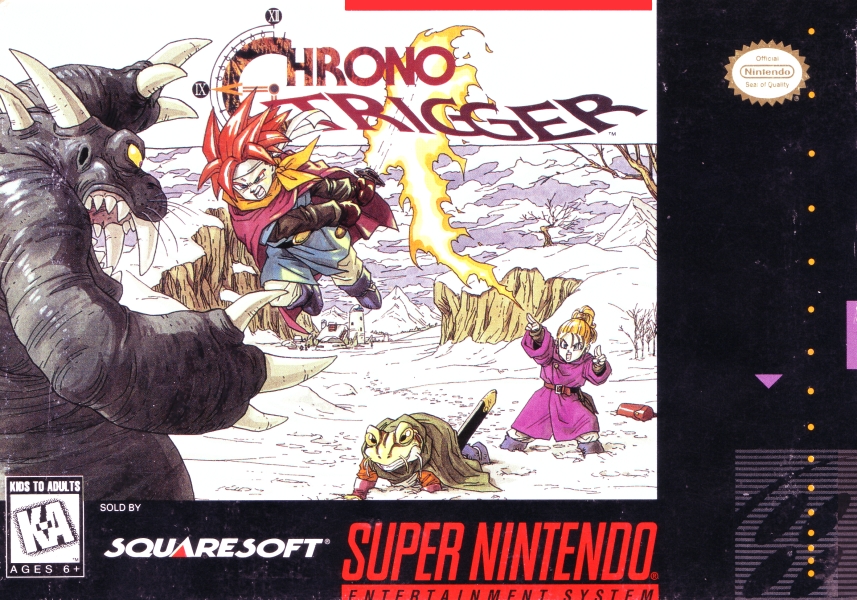
One of the most critically acclaimed games of all time, Chrono Trigger has found a very loyal fan base around the world. It’s hard to make a list of “best video games of all time” without including it somewhere. If it doesn’t fall in the top ten, it must fall shortly thereafter. Certainly, it must go on the list of greatest RPGs, what being made of the Squaresoft “Dream Team” and all. Coming late in the life of the Super Nintendo, it is perhaps the most beautiful SNES game.
And truly, Chrono Trigger is one of the most gorgeous games to grace the Super Nintendo. The sprites are sharp (by SNES standards) and colorful. Even more, the animations are surprisingly smooth and exciting to watch. The special attacks, especially the dual and triple techs, almost never get old. It’s so much more visually interesting than any other RPGs on the SNES.
The layering is also impressive. On the two dimensional world map, for example, you oven find clouds floating overhead, just a bit transparent. In dungeons, you can see the a few different layers of visual elements to give this 2D world more depth. The menus can get a bit awkward. Split between a narrow bar that displays target information and a much thicker bar for your party, the movement of characters can often can obscured by the menus. It’s not usually a problem, but sometimes you can’t really see who you’re actually attacking. You can swap which menu is on top and which is on bottom of the screen – so if an enemy wanders close to the bottom and you can’t really tell if you’re selecting it, you can swap the menu positions so the narrow bar goes to the bottom while the thicker menu goes to the top – but it’s still a little bit clunky of a design.
Of course, one wouldn’t get too far talking about the visuals without mentioning that the character design was done by Akira Toriyama, of Dragonball fame. It has that very distinct Toriyama look, but it ultimately only goes so far given the technical limitations of the SNES. The animated cutscenes in the PS1 re-release alone might be beautiful enough to compensate for the extreme load times.
It’s easy to think of Chrono Trigger in the same vein as the SNES Final Fantasy games. After all, there were a number of key contributors to both games and both were Squaresoft titles. There are a few similarities, of course. Both utilize the ATB system, so you must wait until the gauge fills before you can attack. Characters gain experience through combat, and those experience points earned eventually cause them to level up. Battle also yields tech points, which go towards leveling up the magic. Each character knows a certain number of skills and you unlock the next spell after you’ve earned enough tech points. In some ways, it’s not too unlike the Esper system of Final Fantasy VI, which is often tied to Chrono Trigger because of their Playstation packaging together.
The real strength of the gameplay – and what separates it from the rest – is the combo system. Each individual character can perform his or her own action. They can attack, use a tech, or use an item. When multiple characters learn the appropriate spells and their ATB bars have filled, those two (and later, three) characters can perform “combo moves.” These moves still consume MP, like all tech attacks, but they mix elements of each characters innate abilities. Each character has his or her own strength. Crono is lightning based, Frog and Marle water and ice, Lucca fire, Magus dark, and then the two non-magic based characters Robo and Ayla are fairly strong physical attackers. Combining character attacks is a great way to increase the amount of damage per turn. For example, Ayla is a a fighter and Crono is lightning based, so you could attack with Volt Bite, which charges Ayla with lightning before her physical strike.
Learning more techs, and varying your party, increases the number of dual and triple techs. This provides added incentive to change up your party, as every combination of two and three characters can learn dual and triple techs, but they won’t learn them if you never put them together. This, in addition to character-driven side quests, really makes it a lot more fun since you don’t wind up sticking with just three or four characters through the whole game and so you can actually see what other characters can do.
Other than that though, it is a pretty basic RPG. You use a lot of spells and items. Experience levels your characters while tech points level the spells. Another difference is that there aren’t really random encounters. Instead, most enemies appear on the screen. As there is no option to flee, it’s up to you to try and avoid contact with monsters if you don’t want to fight them. A lot of times you have no choice, but some times you can just run around them. It’s a nice change of pace from the typical “three or four steps and maybe you have to fight something” style of most other RPGs of the time. There are times though where enemies will ambush you, and the mostly respawn if you leave that section of the map, but at least if you go back, you know where they are. It never changes.
There’s also the addition of “New Game +” mode. Given its time travel nature, the game includes over a dozen different endings to the game. It ultimately depends on when you decide to fight Lavos. New Game + lets you keep your equipment and levels (except for the Masamune, which is a plot-derived weapon) as you go through the game again. This means you can challenge Lavos at various points in the game. When you fight Lavos will change what has happened in the world, thus altering the ending. It’s a pretty cool concept, but frankly, the battles were one of the greater strengths of the game. New Game + makes it too easy and boring to play through.
The strength of the game’s narrative is its cast. With a party derived from different time periods, and with each character having their own distinct speaking style and powers, it is hard not to love each character. The central story is not necessarily super compelling or deep, but it’s solid enough to keep players engaged with the characters along the journey. This is especially true as certain sidequests are built off of the time travel aspect.
Everything is improved by the score, as is common with Squaresoft games. Composed primarily by Yasunori Mitsuda with some contributions by Final Fantasy composer Nobuo Uematsu, Chrono Trigger’s score remains one of the greatest scores in the history of video games. Each character has an insanely memorable theme. (At the End of Time, it’s easy to get distracted and just keep switching your party members just so you can hear everyone’s themes.)
It’s hard to really add anything more than how amazing the score is. Sometimes, a track will sound a bit choppy or out of place at first, but after a minute or two, you realize how well it works with everything going on around it. Mitsuda also does an amazing job introducing several leitmotifs to further connect the sound and feeling of each track. There are occasional misfires here and there (granted, very, very slight misfires), but even those don’t hinder the overall quality.
Chrono Trigger remains one of my favorite all-time games, and it rightfully belongs on many Best lists. It does feel a little shallow when comparing to some of the later Square RPGs in terms of narrative, but it’s still extremely fun and has a great many strengths that compensate for any of the weaknesses.
Reductive Rating: Amazing!
Available On: SNES, PS1, Nintendo DS, iOS, Android, Windows
 The Glitch